
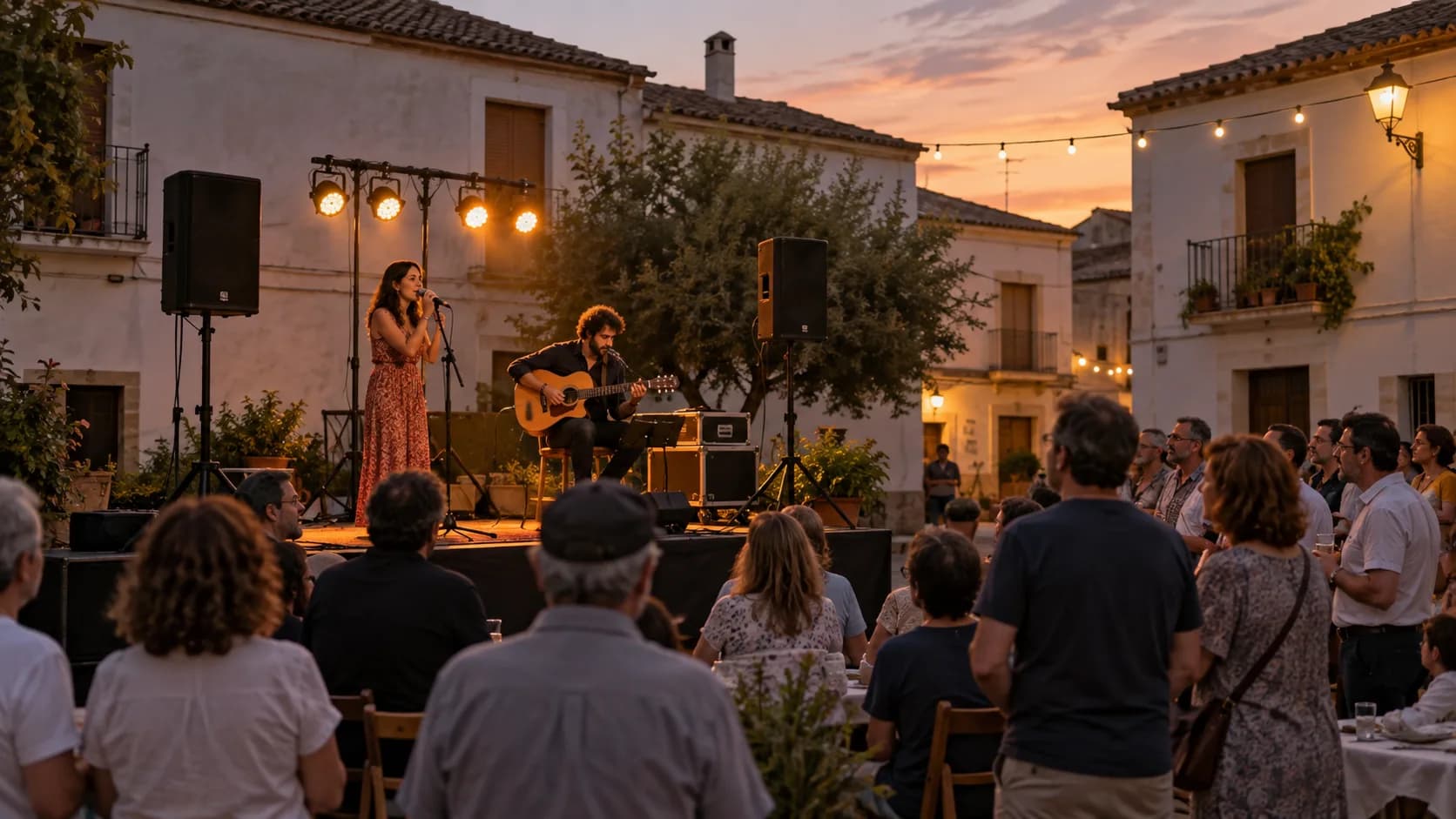
Sounding a town square isn't about piling up speakers: it's about making sure the person in the front row and the one listening from the terrace at the back enjoy the same concert, without the neighbours on the balconies suffering for it. Town squares are the natural stage for festivals and patron saint celebrations in Spain, but they're also one of the trickiest acoustic environments: reflective facades, irregular shapes and an audience scattered every which way. At Zenor Audiovisual we sound squares of every size with our own equipment, and these are the key points we apply in every sound production for events.
First, analyse the square: shape, surfaces and audience
Before talking watts, you need to visit the space. An arcaded square with stone facades generates reflections that blur the voice; an elongated square forces you to split the system; an open esplanade loses pressure with distance and wind. During the technical site visit we measure the distances from the stage to the furthest point of the audience, locate the power points, identify the most exposed homes and decide where the sound towers will go so as not to block emergency exits. That prior analysis shapes the whole design, and it's part of the service we provide to the town councils we work with.
How much power do I need? Think in SPL, not just watts
The classic question is "how many watts are needed?", but the correct answer is measured in sound pressure level (SPL) over the audience. For an outdoor concert, the usual target is to deliver between 95 and 100 dB SPL evenly across the whole audience area, with headroom for the peaks in the music. The amplifier's watts are only part of the equation: what matters is the sensitivity of the cabinets, their coverage and how far away the audience is. If you want to dig deeper into this relationship, we explain it with examples in how many watts of sound do I need for my event. As a rough guide:
- Up to 200-300 people: full-range system with subwoofers, typical of performances in small squares.
- 500-1,000 people: mid-format amplified system with subwoofers in a controlled configuration.
- 1,000-3,000 people: compact-format line array with a subwoofer arrangement and dedicated processing.
- Over 3,000 people or very deep squares: mid-format line array and delay towers.
Delay towers: covering long squares without punishing the front rows
The classic mistake is turning up the main PA volume to "reach the back": the result is a deafened front row and a back that's just as poorly served. The professional solution is delay towers, secondary systems placed at mid-distance that reinforce the sound where the main system no longer reaches. Since sound travels at around 343 metres per second, each tower must be electronically delayed by around 3 milliseconds per metre of separation from the stage so that both signals arrive aligned at the listener; otherwise, echoes are perceived and intelligibility is destroyed. In line array systems, moreover, vertical aiming is critical: an error of just a few degrees leaves entire zones of the audience without coverage or fires energy straight into the facades.
Coverage and noise control: sounding good without disturbing anyone
Good square sound design directs the energy toward the audience and steers it away from homes. We work with directional subwoofer arrangements (cardioid or end-fire) that reduce the low end leaking into the balconies behind the stage, aim the systems away from the most sensitive facades and cap the system at the level agreed with the town council. It's not just courtesy: Spain's Ley 37/2003 del Ruido (Noise Act) and local bylaws set limits and schedules that the organiser must respect. All of this is documented alongside the rest of the event's paperwork, which we cover in our guide on public liability insurance and permits for municipal events.
“The best sound design for a square is the one nobody talks about: the audience hears perfectly everywhere and the neighbours sleep soundly once the festival is over.”
Common mistakes when sounding a square
- Sizing the system by "catalogue" watts instead of by target SPL and real distance.
- Skipping delay towers on deep squares and compensating by raising the overall volume.
- Placing subwoofers without a plan, creating dead low-end zones and rattling balconies.
- Not planning the power supply: an undersized generator can bring the concert down at the worst moment.
- Forgetting the soundcheck with the band or artists before opening the square to the public.
If the event includes live camera production or projection, well-placed LED screens complete the experience for the audience at the back. And all of it, with setup, operation and teardown handled by our own technical team, deployed anywhere in Spain.