
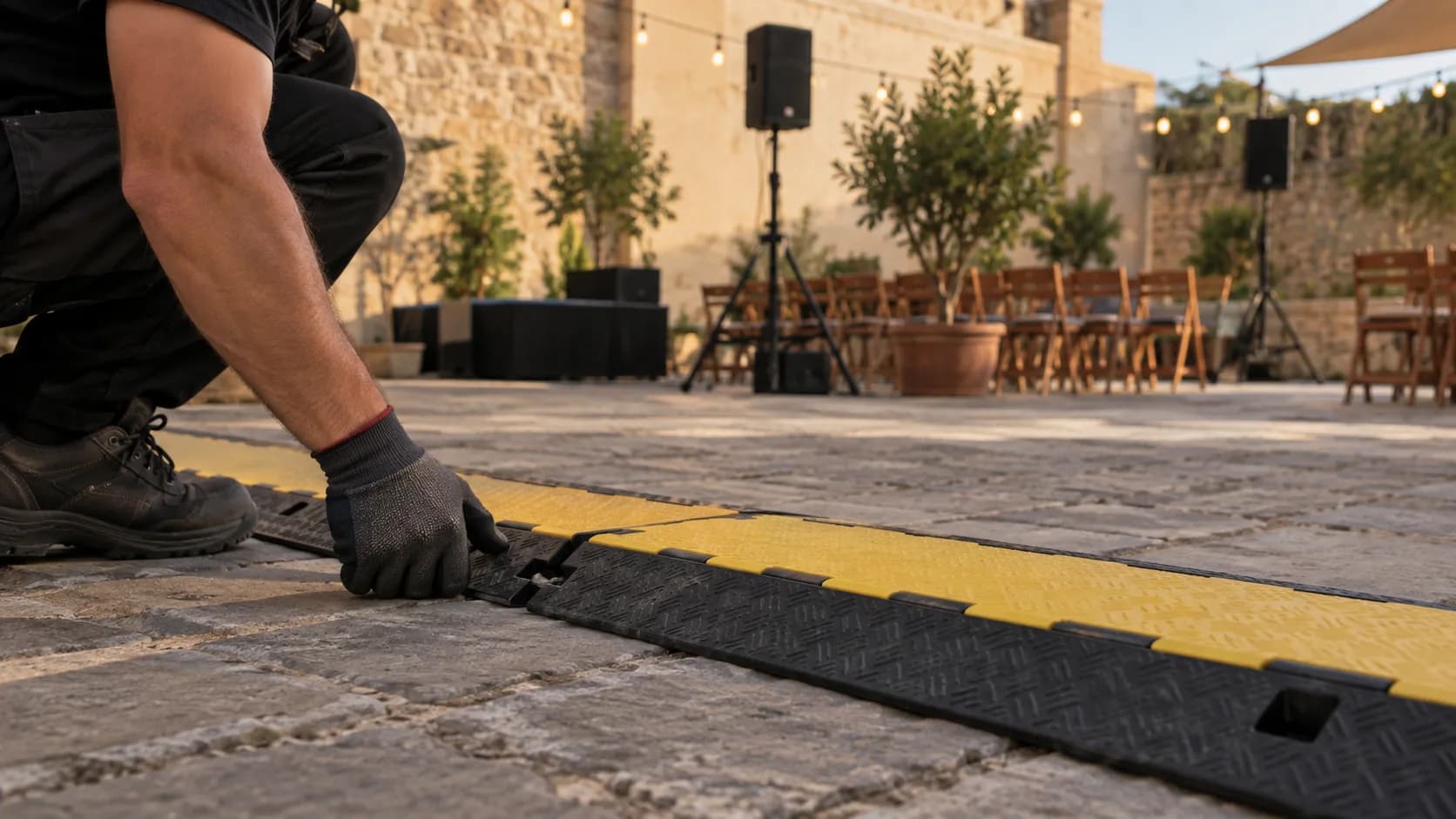
Yes: public liability insurance is compulsory in order to hold a public event in Spain, and the minimum sum insured is set by each autonomous community according to capacity. Without a policy there is no authorisation. Alongside the insurance, a municipal event usually needs an entertainment licence, a permit to occupy the public highway, an electrical installation certificate and structural certificates.
It is the question councils and cultural officers put to us most often, almost always three weeks before the opening speech. We have spent years working with town halls across Spain, so this guide sets out what has to be closed off and in what order.
Is public liability insurance compulsory at public events?
Yes. National legislation on public entertainment, whose historical framework is the General Regulation on the Policing of Public Entertainment and Recreational Activities published in the BOE, and above all each autonomous community's own entertainment laws, require the organiser to hold a liability policy before authorisation is granted. Each region sets minimum sums insured according to capacity: a performance for 200 neighbours is not the same as a street party with thousands of attendees. Holding an event without that cover counts as a very serious infringement and can carry fines of tens of thousands of euros, as well as immediate suspension of the event.
What a liability policy for events covers, and what it does not
The policy answers for personal injury, property damage and financial loss suffered by third parties during the build, the event itself and the derig. Three points are worth checking before signing anything off:
- That the sum insured meets the minimum set by regional legislation for the expected capacity.
- That the cover includes the build and derig of structures, stages and sound and lighting towers, not just the hours of the show itself. This is the point most policies leave out.
- That the supplier's employers' liability cover extends to their own technical crew, something many municipal tender documents now require explicitly.
Permits and paperwork before a village festival or a concert
Besides the insurance, a municipal event strings together several authorisations, and it pays to start them weeks in advance. These are the most frequent ones:
- Entertainment licence or responsible declaration, under the applicable regional law.
- Occupation of the public highway and, if roads are to be closed, coordination with the local police.
- A safety or self-protection plan where capacity requires it, with medical and emergency provision.
- Certificate for the temporary electrical installation, signed by an authorised installer.
- Certificates for the structures (stage, PA towers, line goalposts) and for the technical supplier's liability policy.
- Compliance with noise legislation: Law 37/2003 on Noise and the municipal by-laws set the permitted hours and emission limits.
Who takes out the insurance: the town hall or the technical company?
It depends on who is named as organiser. When the town hall organises directly, it usually relies on its municipal policy and requires each supplier to hold their own. And that is the key point: we carry our own public liability insurance and hand the town hall every document the file needs (policy certificate, structural certificates and electrical certificates) before the build starts. We work with the town clerk and the municipal technical staff so that the paperwork never holds up the festival, in the same way we look after the technical side of sound for events in the open air.
“A complete file two weeks before the event saves more trouble than any last-minute improvisation: the paperwork is part of the show too.”
Quick checklist for councils and municipal technical staff
- Confirm the estimated capacity and the minimum liability sum required by the autonomous community.
- Ask each supplier for their insurance certificate and the technical documentation for the structures.
- Check the music hours permitted by the local noise by-law.
- Close off the emergency plan and the medical provision if capacity requires it.
- File everything before the first day of the build.
If, beyond the permits, you are worried about the concert sounding right across the whole square, we cover that in our guide on how to put sound into a square for concerts and street parties. And for specific questions about documentation, the most common ones are answered in our FAQ.