
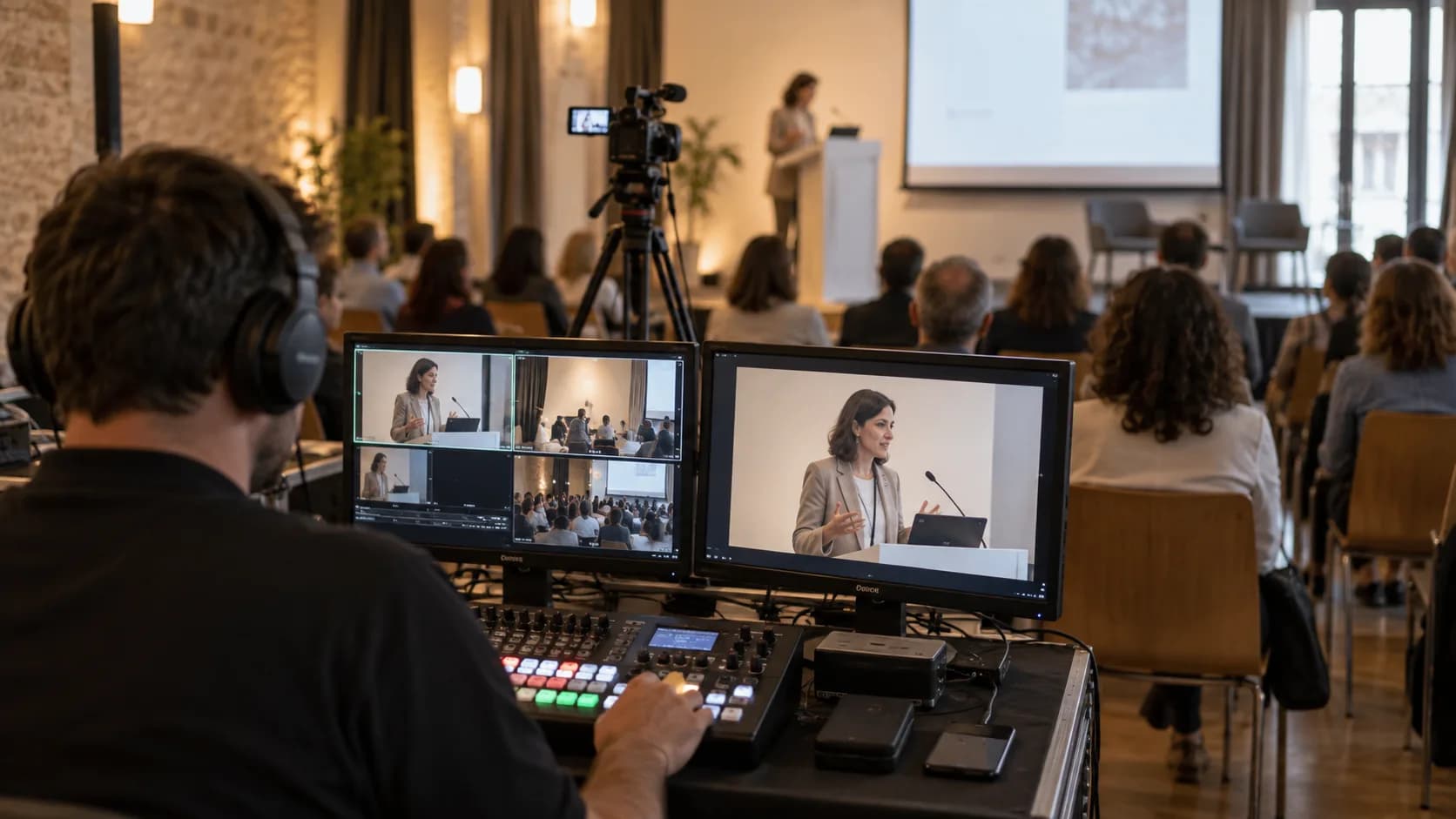
If the event is at a country estate, in a town square or in a sports hall without fibre, we bring our own internet connection: a Starlink dish that receives the signal by satellite and that we use only for the broadcast. That way the event live stream doesn't depend on the venue's wifi or on mobile coverage, which saturates as soon as a few hundred people gather with their phones in hand.
Why a live stream goes down at an event
The number one cause of a dropped broadcast is the network, not the camera. To stream, what matters is the upload speed, not the download, and it has to stay stable for hours. What we find most often: hotel wifi shared with two hundred attendees, an office router with a firewall that blocks the stream, or an estate where 4G works fine at midday and collapses in the afternoon, just as the guests arrive.
What Starlink is and why it works for an event
Starlink is SpaceX's satellite internet service. Its satellites orbit much lower than traditional satellite internet, so the delay is close to that of a land connection: enough to broadcast live. For us it has three advantages. It doesn't depend on the venue having a line, it doesn't compete with the audience's phones and it is set up on the day of the event.
How we set up the connection
- Before the day, the site. The dish needs a clear view of the sky. Trees, a marquee or the wall of a sports hall can block part of the signal, so we decide where it goes from photos or a site visit.
- Upload test on site. Starlink speed varies with the area and the time of day. We measure the upload on site and set the broadcast quality with a margin: our rule is to have at least twice the broadcast bitrate.
- Power and cable. The dish goes on its own socket and the connection reaches the encoder by cable. That line is only for the live stream.
- Plan B. At large events we add a second route, the venue's line or mobile data, so that a dropout doesn't cut the broadcast.
Where we use it
Anywhere there is a broadcast and the connection isn't guaranteed: weddings at country estates, town festivals in the square, outdoor competitions, fairs at temporary venues or conferences in hotels whose network won't let the stream through. Also when the venue does have a connection but we don't want to bet the live stream on it.
We size this connection for the broadcast. If you also need internet for running the event, tell us in the brief and we'll look into it.
What we need to know
The exact address, whether it's indoors or outdoors, whether the venue has a line and who manages it, and which platform you want to stream to. With that we can tell you whether the venue's connection is enough or we bring our own. The rest of the set-up, cameras and live production, is in how to run a multi-camera live stream of an event.