
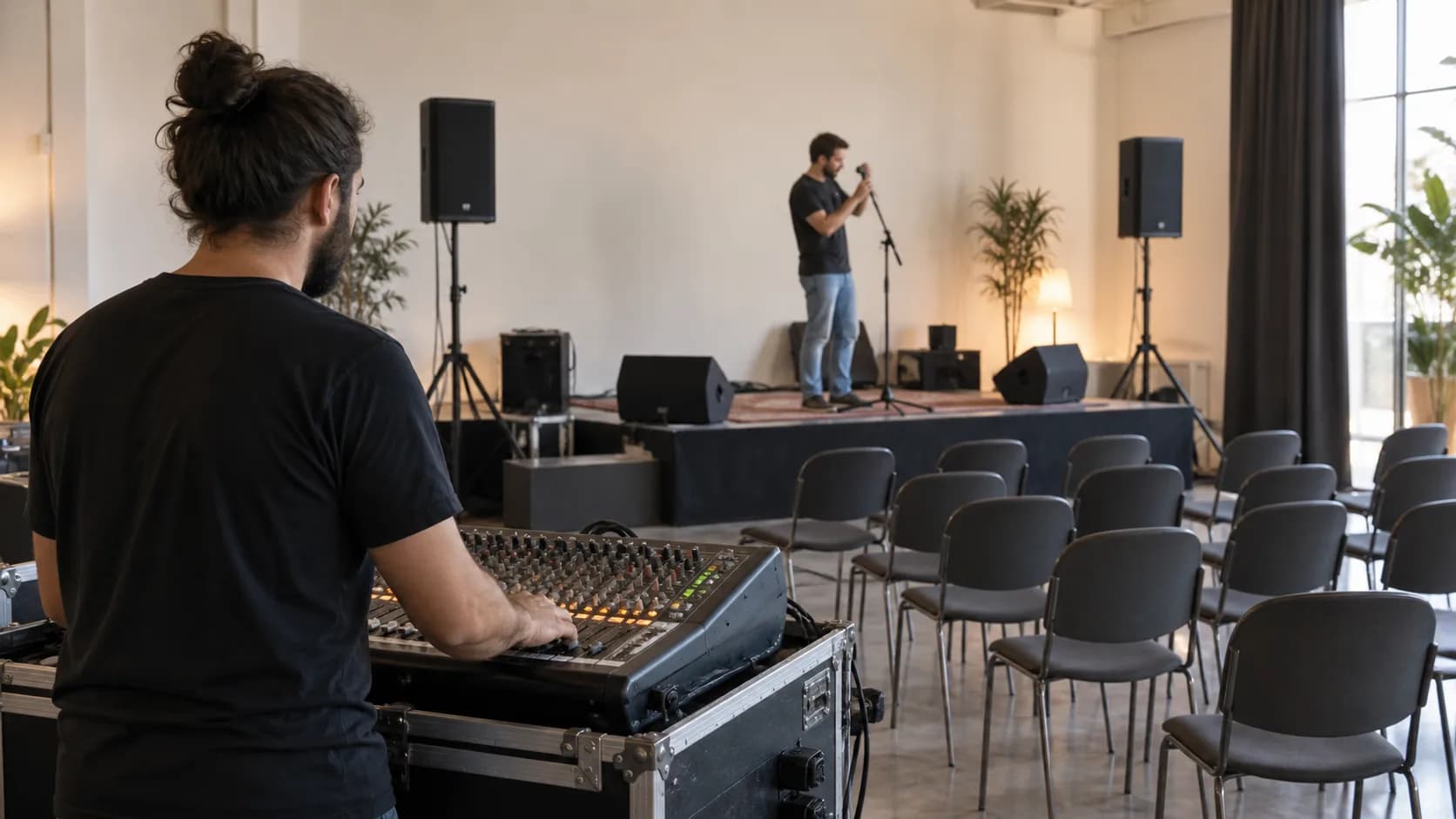
When people ask for a sound quote for an event, the line item hardest to understand is the engineer. You can see and touch the equipment; the engineer looks like somebody standing there just in case. The reality is that most of their work happens before the first guest arrives, and that what they do during the event is exactly what nobody notices when it goes well.
Before: the get-in and the sound check
A sound system is not placed where it looks tidy, it is placed where it covers. That means deciding speaker positions based on the shape of the space and where people will sit, flying or raising whatever needs height, and running cable where nobody will trip on it. Then comes the check: setting levels, testing every microphone, and listening to the room from the back, which is where you find out whether the sound arrives or dies on the way. In a well planned get-in, this is finished with time to spare before the doors open.
During: the part you do not see
Live, the engineer is correcting continuously. A speaker who talks quietly and one who eats the microphone cannot sit at the same level. An empty room and the same room with three hundred people sound different, because bodies absorb sound. And when something starts to ring, the difference between half a second of feedback and ten seconds is whether somebody has a hand on the desk.
- Adjusting the level of each microphone depending on who is speaking
- Compensating for the change in acoustics as the room fills up
- Catching feedback before it becomes audible
- Handling changeovers between speakers or between bands
- Swapping a battery or a microphone mid-show without it showing
- Coordinating with the organisers when the running order slips
Why hiring the kit on its own usually costs more
It is a legitimate option and sometimes the right one: if somebody in the organisation knows how to run it, hiring equipment without an engineer is cheaper. The problem appears when that person does not exist and it gets improvised. A badly placed system sounds worse than a more modest one placed well, and a live failure with nobody to fix it does not get fixed: it gets endured. That is why our proposals include the engineer unless the client specifically asks for equipment only.
How many engineers you need
It depends on how many things are happening at once. A company lunch with a microphone for two speeches is comfortably handled by one person. An event with a stage, several speakers, lighting that changes and a live broadcast involves simultaneous jobs that one person cannot cover without something suffering. When a quote shows two technicians it is not an upsell: it means there are two positions to cover.
“An engineer's work is measured by what did not happen. It is a trade with terrible marketing.”
Our own equipment, our own engineers
At Zenor Audiovisual both the equipment and the people are ours, and that changes two practical things. The first is that the engineer who turns up at your event knows the system they are about to rig, which is not the same as arriving to operate unfamiliar kit. The second is that if something fails, there is somebody from the team standing right there to solve it, not a phone number to call. We work this way across Spain from our base in Albacete, with event sound sized for each space.
What we need to know to quote it
We do not publish fixed rates because the price depends on capacity, the space, the hours and the travel involved. With the date, the town, how many people you expect, the start and finish times, and what has to be heard — speeches, music, a live band — we prepare a proposal with the specific equipment and staff. A person on the team reviews it before it goes out.