
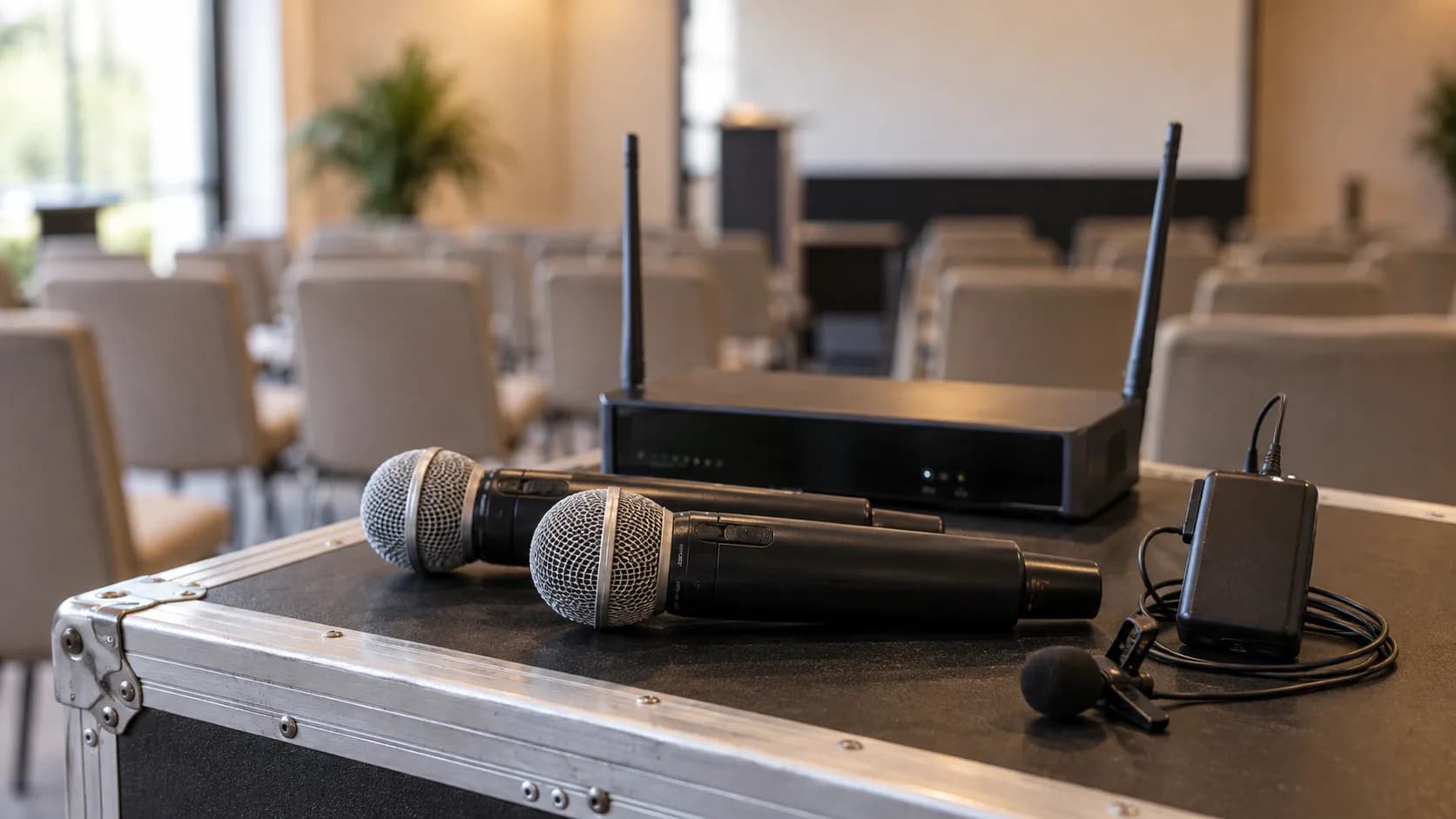
A good wireless microphone is the difference between vows that move people and a ceremony where nobody can hear a thing, or between a talk that flows and a conference full of squealing. Wireless microphones for weddings and conferences have their own rules: which type of microphone to choose, which frequencies to work on and how to position the system so that it does not feed back. We explain it all with the experience of hundreds of events covered by our professional sound team.
Types of wireless microphone: handheld, headset, lavalier and desk
- Handheld: the all-rounder. Ideal for speeches, question and answer sessions and masters of ceremonies. Because it sits close to the mouth, it carries the lowest risk of feedback.
- Headset: the capsule stays fixed next to the mouth even if the person turns their head or walks about. Perfect for officiants, presenters on the move and trainers.
- Lavalier (clip-on): almost invisible in photos and video, a favourite for vows and interviews. In exchange, it picks up from further away and is usually omnidirectional, so it takes more craft to keep feedback at bay.
- Desk or podium: for lecterns and round tables, where the speaker should not have to think about the microphone.
At a wedding we usually combine several: a headset or lavalier for whoever is officiating, a lavalier for the couple and a handheld for readings and guests. That way nobody has to handle equipment and the technician controls each source separately. There is more detail on the full set-up in our article on sound for an outdoor wedding ceremony and on the weddings and celebrations page.
Frequencies and interference: so nothing cuts the moment short
Professional systems work in the UHF band, whose use in Spain is regulated by the Cuadro Nacional de Atribución de Frecuencias published in the BOE. Before every event you have to scan the spectrum at the venue itself and coordinate free frequencies: what worked in one function room can suffer interference in another because of local digital terrestrial television or other wireless equipment. Domestic 2.4 GHz systems compete with the Wi-Fi and the guests' mobile phones, which is why we avoid them at events with an audience. Every microphone needs its own frequency and new or freshly charged batteries: it sounds obvious, but half of all live failures start there.
Why a microphone feeds back (and how to prevent it)
Feedback, that squeal, is a physical phenomenon called acoustic feedback: the microphone picks up the sound coming out of the speaker, the system amplifies it again and the loop takes off as a whistle. It is not bad luck, it is geometry and gain, and that is why it can almost always be prevented.
- Place the speakers in front of the microphones, never pointing at them.
- Use cardioid or supercardioid capsules, which reject sound arriving from behind.
- Speak close to the microphone (5–10 cm on handhelds): the further away, the more gain is needed and the greater the risk.
- Set the input gain properly (gain staging) instead of pushing the master fader up blindly.
- Equalise the room and use filters on the frequencies that start to whistle.
- Mute any microphones that are not in use: an open mic left on a table is feedback waiting to happen.
Wireless microphones at conferences and conventions
At a convention the microphone count multiplies: speakers on headsets, panel discussions with several mics, a question and answer session with handheld wireless units flying around the room… The key is having a technician managing the mix live and coordinated spare microphones in case something fails. Our conference sound service includes frequency scanning, a technician in the room and a feed to recording or streaming. If you are organising one, our audiovisual checklist for a convention will save you more than one scare.
“Feedback during the vows or the opening keynote is not something people forget. Neither is an attentive technician with coordinated frequencies: nothing happens at all, which is exactly what should happen.”
How many wireless microphones do I need?
- Wedding ceremony: 3–4 (officiant, couple and one handheld for readings).
- Speeches at the banquet: 1–2 handhelds circulating between the tables.
- Company presentation: 1 headset for the speaker and 1 handheld as back-up.
- Panel discussion or convention: one per participant plus 1–2 handhelds for the audience, with a mixing desk and a technician.