
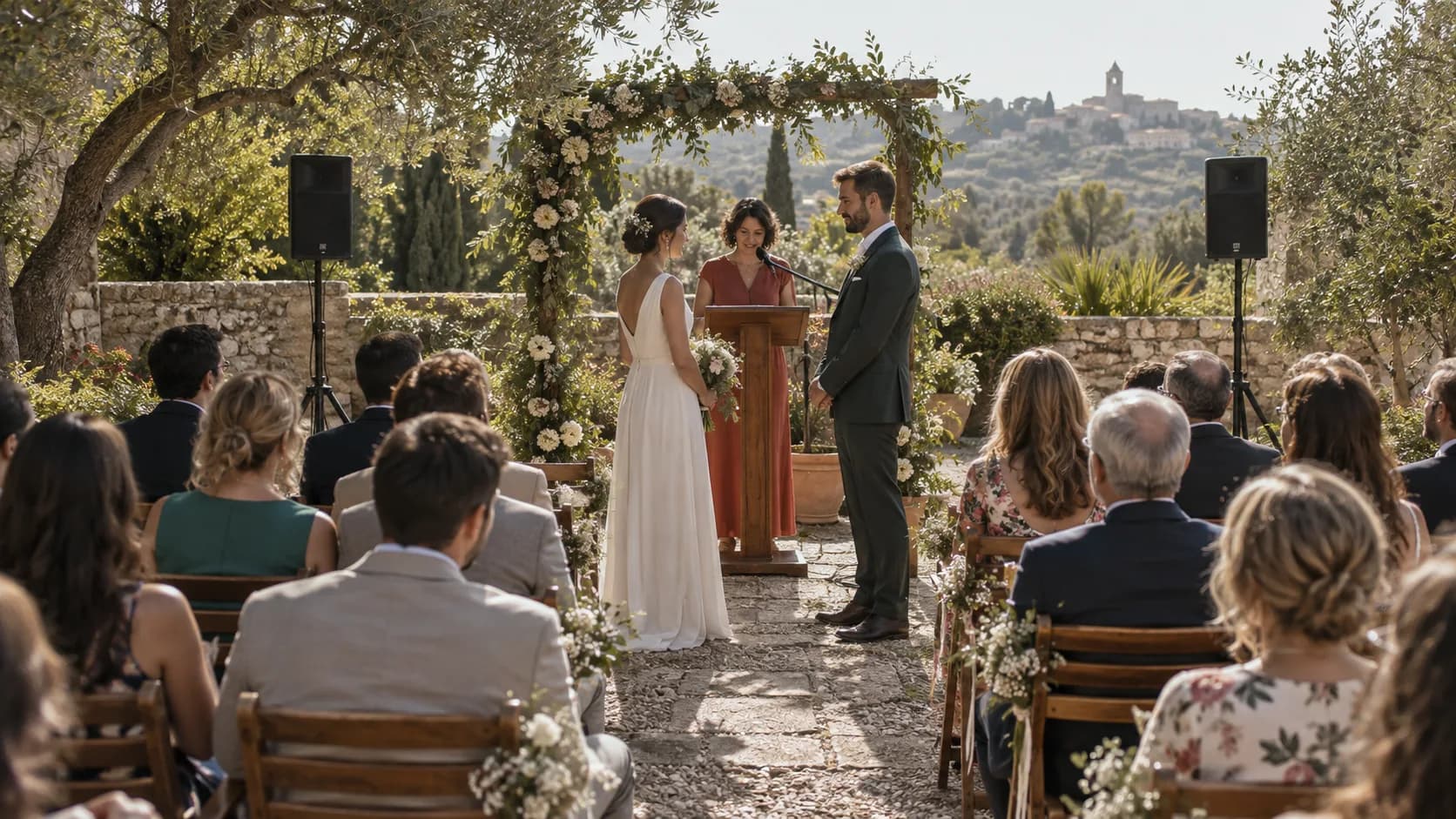
The vows are the most important moment of a wedding… and the one that is lost most often. At an outdoor ceremony there are no walls to help the voice, the wind works against you and the guests in the back rows end up reading lips. The good news: with well-planned sound for an outdoor wedding, even the shyest whisper reaches everyone clearly. At Zenor we provide sound for weddings and celebrations all over Spain, and this is the guide we wish every couple had had before their big day.
Why outdoors is a different sport
In a function room, sound bounces and reinforces itself; in a garden, a country estate or on a beach, it disperses and disappears. Add to that the ambient noise (wind, birds, a nearby road), the long distances between the altar and the back row, and zero acoustic support. The practical rule: from 30 or 40 guests outdoors, professional sound stops being optional. It is not about turning the volume up, but about the voice reaching every seat clearly and naturally.
Microphones for the couple and the officiant: discreet and reliable
The voice is the star of the show, and every person in the ceremony needs their own solution. A badly chosen microphone shows up in the video forever; a well-chosen one is not noticed at all.
- Officiant or master of ceremonies: wireless headset or lapel microphone, hands free
- The couple: discreet lapel mics or a shared handheld wireless mic for the vows
- Guest readings: a wireless handheld microphone on a lectern, easy to use
- Live music: specific microphones for voice, guitar, violin or a quartet
- Always with windshields: air hitting the capsule ruins any pick-up
Speakers: less volume, better distributed
The classic mistake is to put two huge speakers next to the altar: the people at the front suffer and those at the back still cannot hear. The professional solution is to distribute several lower-power sound points along the guest area, aimed and equalised so that the level is even. With a properly sized sound system for events and a technician controlling the mix live, feedback is avoided and the level can be adjusted on the fly when the wind changes or more guests turn up than expected.
Wind, sun and power: the three enemies of the outdoors
The wind hits microphones and can knock over badly weighted stands: windshields, secured tripods and attentive monitoring solve it. The sun punishes equipment and screens: it is better to shade the technical area. And power is the question nobody asks until the last day: is there a socket near the altar, or do we need a silenced generator or battery-powered equipment? During the site visit we check all three, we measure distances and we decide where each element goes so that on the big day everything is already sorted.
“When the sound is properly sorted, the couple do not have to project their voices or worry about whether they can be heard. That peace of mind shows in the photos.”
The ceremony music: entrances, key moments and the exit
The same installation that amplifies the vows is used to play the music for the entrance, the signing and the exit with quality and at exactly the right second, or to amplify live musicians with care. It is worth planning in advance what plays at each moment: in this guide we explain how to prepare the perfect playlist for your party, and much of the advice applies to the ceremony too. And if you are wondering how much you should set aside for all this, here we break down how much the audiovisual side of a wedding costs and what it depends on.
One last note: always ask for a sound check before the ceremony and confirm who will be controlling the levels while you speak. If the space is tricky (a lot of wind, a slope, separate areas), tell us and we will solve it during the technical visit. You will find more answers in our frequently asked questions.