
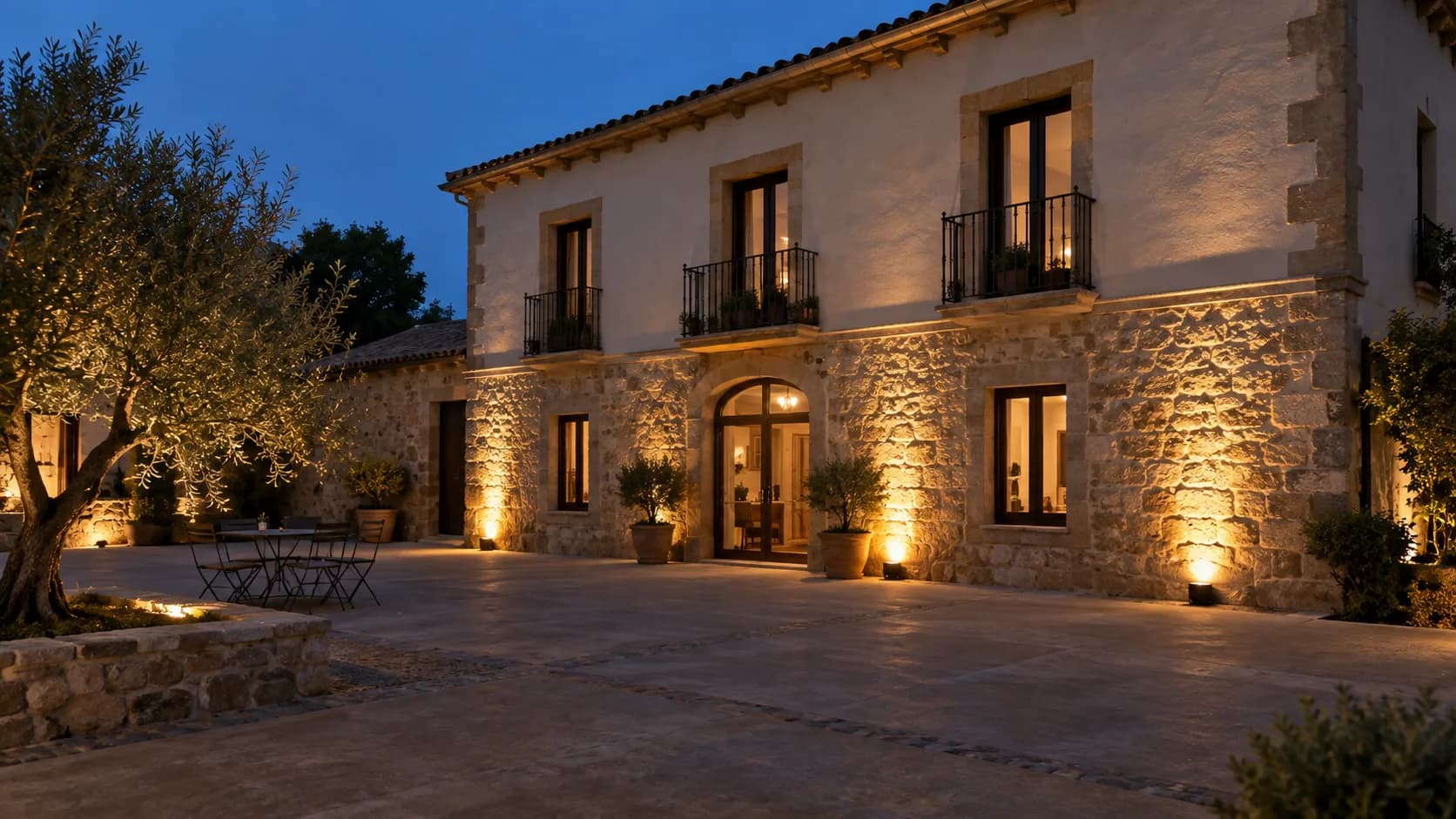
Architectural lighting for facades and buildings is having a golden moment in Spain: more and more councils are lighting up their heritage to give it a second life once the sun goes down, and more and more businesses understand that their headquarters or their stand also communicate at night. Done well, a lit-up facade attracts tourism, strengthens the identity of a town or a brand, and, with LED technology, uses a fraction of the power it did a decade ago. At Zenor we do it with our own equipment as part of our lighting service, for one-off events as well as more ambitious permanent showcases.
What architectural lighting is and why it's booming
We're talking about using light as a design tool: it's not about "lighting up" a building, it's about telling its architectural story by choosing which volumes, textures and details are seen and which stay in shadow. The leap forward in LED and control systems has made affordable what was once the preserve of major capitals: today a mid-sized town council can light its church, its tower or its town hall with low-consumption projectors, change colour on special dates and programme switch-on schedules without touching a single fixture.
Facade lighting techniques that work
- Wall washing: uniform light that brings out the whole facade; the basis of almost every project.
- Grazing: projectors placed close to the wall that dramatise the texture of stone, brick or ironwork.
- Accenting: pinpoint spots on coats of arms, balconies, arches or bell towers.
- Silhouette and backlighting: cutting out towers or sculptures against an illuminated background.
- Gobos and projections: projecting logos, Christmas motifs or textures onto the wall.
- Dynamic RGBW colour: scenes that change for dates, events or campaigns.
When the project is dynamic — colours that evolve, sequences synced to music at a launch event — everything is governed by professional control protocols. If you're curious about the technical side, we explain how it works in what is DMX and how a stage is lit: the same technology we use at concerts is used to paint a facade.
Lighting ideas for councils
- Permanent showcase lighting for a church, castle, clock tower or town hall.
- Commemorative colours on special dates: international days, local celebrations, tributes.
- Spectacular lighting for fairs and patron saint festivals, with switch-on ceremonies that become a public event.
- Scenic lighting of squares for concerts and civic events.
- Christmas projections and ambient lighting with no building work or fixed installation.
- All handled turnkey: that's how we work with town councils across Spain, and it's how our real projects look.
Architectural lighting ideas for businesses
For a business, lighting up its building is advertising switched on every night: corporate facades in brand colours, headquarters openings with light sequences, anniversaries with the facade as the star, or product launches where the building itself becomes part of the show. In corporate events we design lighting as part of the event's story, not as a decorative add-on.
Energy efficiency and light pollution: regulations matter
Lighting well also means lighting with your head. Outdoor lighting in Spain is regulated by Royal Decree 1890/2008, which sets levels and efficiency requirements for installations, and more and more municipalities require control of light pollution: light aimed only at the facade, with no spill into the sky, appropriate colour temperatures and programmed switch-off times. The good news: a well-aimed LED project uses less power, pollutes less and looks better than the old halide projectors.
“A well-lit facade doesn't need more light, it needs better light: just enough, in just the right place, and only when it adds something.”
Permanent installation or lighting for an event?
Building work isn't always necessary. For a fair, a centenary or a Christmas campaign, renting architectural lighting transforms a building for days or weeks with no fixed installation: we set up, programme, operate and dismantle. If the goal is permanent, we plan the project in phases with a prior technical and visual proposal. Either way, the first step is the same: tell us which building you want to light up and request a quote, no obligation.