The music for a wedding ceremony is organised by moments: the guests arriving, the entrance, the readings and the vows, the rings or the signing, and the exit. At a civil wedding you and your partner decide almost everything; at a religious one, the first step is to ask the parish what can be played and how.
In both cases someone has to start each piece on cue and the vows have to be heard, so it makes sense for the music and the microphones to come from the same event sound setup.
What plays at each moment of the ceremony
- Guests arriving. Background music, at low volume, while people take their seats. It is also a way to know the sound works before you start.
- Entrance. This is the piece that needs timing the most: it has to last as long as the walk down the aisle. If the bride or the wedding party arrive earlier, the music is faded out gradually rather than cut off abruptly.
- Readings and vows. No music, or barely audible. This is the microphone's moment: whoever is speaking must be heard right to the back row.
- Rings and signing. Short or instrumental pieces. The signing can take longer than planned, so it is worth having music to spare.
- Exit. Usually the most upbeat and the loudest. It usually leads straight into the cocktail reception, so this is the moment to switch to the music for afterwards.
The list to give whoever starts the music
Many problems at a ceremony are not technical but about coordination: nobody knows which song comes next or when it starts. A simple sheet for the person running the music prevents them:
- The order of the moments and the piece for each one, with the exact version ("the one from the film" won't do).
- The songs downloaded onto the equipment, without relying on the venue's mobile signal.
- The second at which each one starts, if not from the beginning.
- Who gives the cue for each entrance: the officiant, the person organising or someone from the family.
- What to do if a moment runs long: repeat, move on to another piece or lower the volume.
Civil ceremony: at a country estate, a town hall or a courthouse
If the civil ceremony is at the same estate as the reception, you choose the music, and the most practical option is for the ceremony equipment to be the same one used afterwards for the cocktail reception and the party. If it is at a town hall or a courthouse, ask beforehand whether you can bring sound equipment and how long the ceremony lasts, so you know whether there is time to set up and what fits in the room.
Religious ceremony: what to ask the parish
For a church wedding, ask the parish what music can be played and whether it can be amplified before booking musicians or arranging sound. Also ask whether the church has its own PA system and whether it can be used. If the microphones or the musicians come from outside, this has to be coordinated with whoever is in charge of the church that day.
The acoustics are the opposite of outdoors: the sound bounces off walls and vaults, and if you turn up the volume the voice becomes muddy. It works better to have the microphones close to whoever is speaking and the speakers at a moderate volume than to try to fill the church with sheer power.
Recorded or live music
With recorded music, all you need is good equipment, the list ready and someone paying attention to start it. With live music (a guitarist, a quartet, a choir or a band), each voice and instrument needs its own microphone and someone mixing during the ceremony so the music does not drown out whoever is speaking.
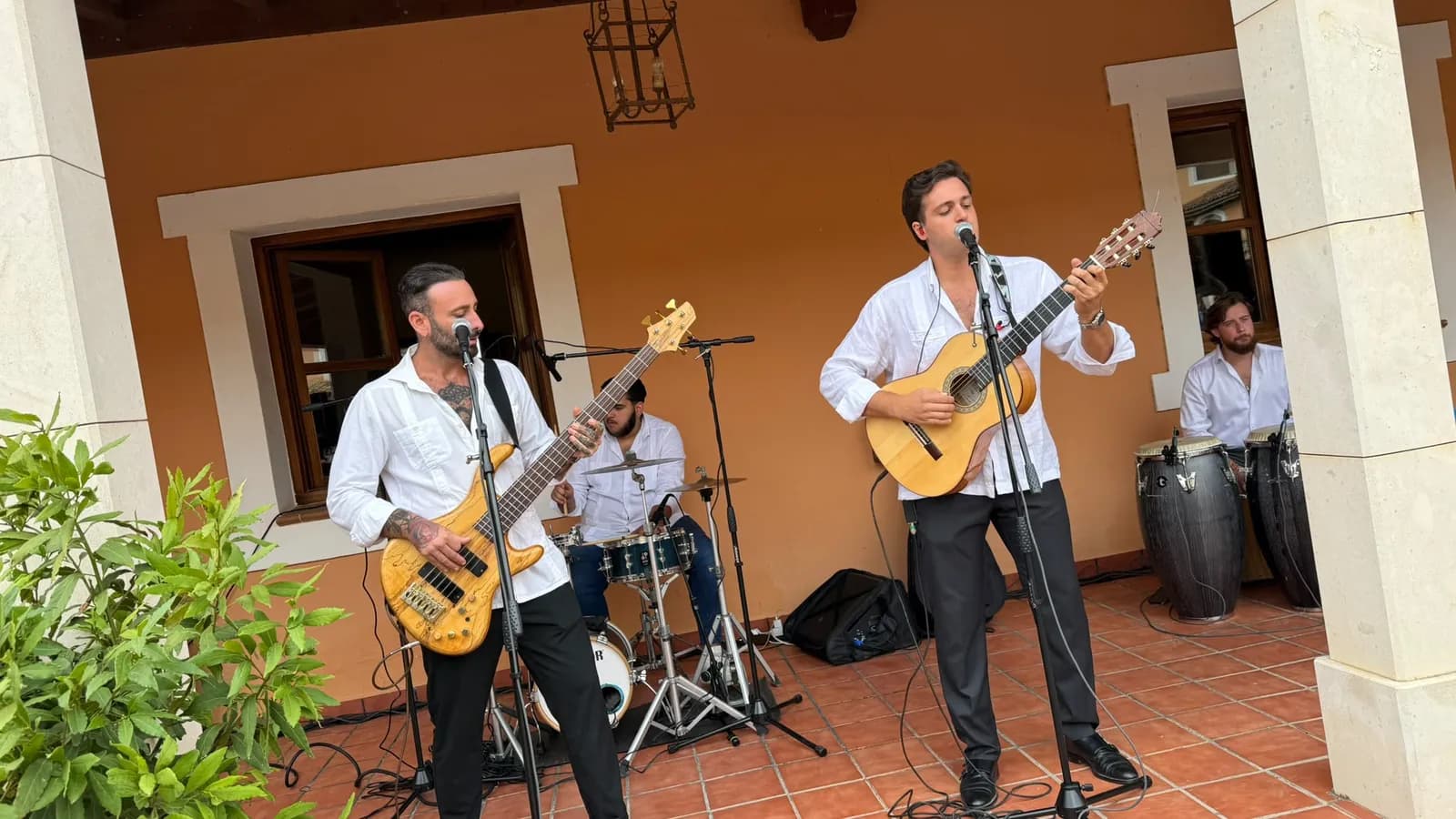
With a band, the setup is like a small concert. For Califa Jerezano's live set at a wedding at Los Aljibes (it was not the ceremony, but the band's performance in the courtyard) we miked the vocals, the drums and the percussion, and set up monitors so the musicians could hear themselves; we tell the story in wedding sound at Los Aljibes with Califa Jerezano. To choose the microphones for the officiant, the couple and the readings, you will find the types in wireless microphones for weddings.
If the ceremony is outdoors
In a garden or on an estate the problem is the opposite of the church: the sound gets lost because there are no walls, and you have to allow for the wind and for where to plug in the equipment. We explain it step by step in sound for an outdoor wedding ceremony.
What to tell us so we can prepare the ceremony sound
- Where it is: church, courthouse, town hall or estate, and whether it is indoors or outdoors.
- Approximate number of guests.
- Whether the ceremony is at the same place as the reception.
- Recorded or live music, and what line-up is playing.
- Who speaks: officiant, readings, a family member.
- The conditions set by the parish, the courthouse or the estate.
If the party follows the ceremony, the same team can take care of the DJ: we explain what it costs in how much does a mobile disco cost. Everything we set up at a wedding is in weddings and celebrations.