
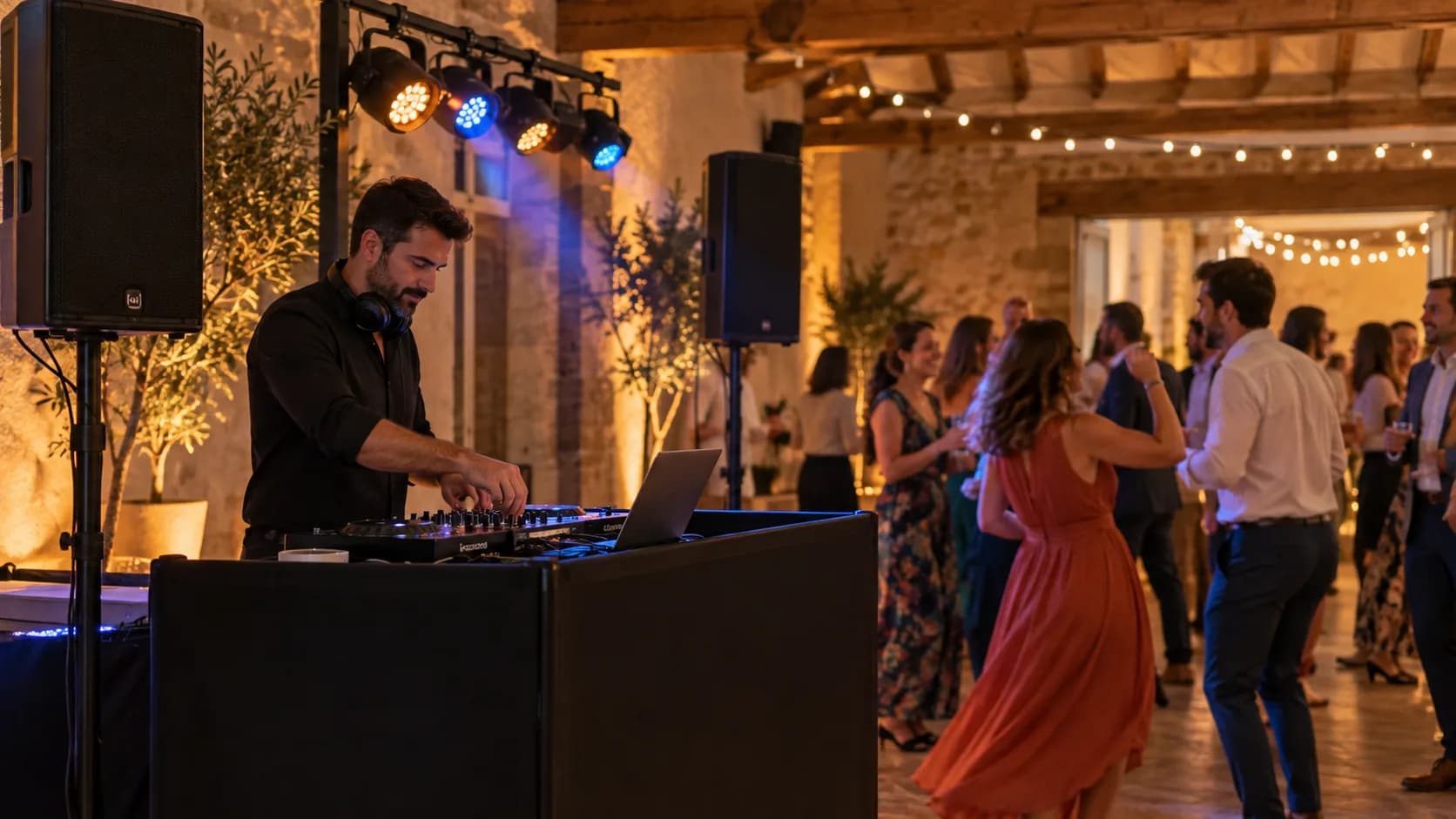
"Should I book a DJ or a mobile disco?" It's one of the questions we get asked most when someone starts planning a wedding, a birthday or a corporate party. And it's normal for it to cause confusion, because the two services share a protagonist — the music — but they're different things: one is a professional, the other is a complete service that includes that professional. In this guide we explain the real differences, no smoke and mirrors, so you can choose wisely based on your event, your venue and your budget.
What a DJ actually does
A disc jockey is the person who selects and mixes music live, reading the dance floor to decide what plays at each moment. Booking "just a DJ" makes sense when the venue already has professional equipment: a function room with sound and lighting installed, a nightclub or a venue with a booth. In that case, the DJ arrives with their music and experience, plugs into the existing system, and starts mixing.
- Ideal if the venue already has professional sound and lighting in good condition.
- Less logistics: no large set-ups or equipment transport.
- The result depends entirely on the quality of the equipment already at the venue.
What a mobile disco includes
The mobile disco is the complete package: a professional DJ, sound equipment sized to your number of guests, party lighting, a booth, transport, set-up, a technical test and take-down. It's the logical choice when the venue has no equipment of its own — a marquee, a country estate, a garden, a pavilion or the street — or when it does but it isn't up to scratch. At Zenor, lighting is also synced with the music, and we adapt the set-up to the space: a room with a low ceiling isn't the same as an open-air threshing floor.
- A turnkey service: sound, lights and DJ arrive together, tested and coordinated.
- Equipment sized to your event: no dance floor you can't hear and no oversized rig.
- A visual experience: dance lighting, effects and atmosphere that a solo DJ can't provide.
- A single technical contact from start to finish, with no passing the blame between suppliers.
Five questions to help you decide
- Does the venue have professional sound and lighting equipment? If the answer is no, you need a mobile disco.
- How many guests will there be? From around 80-100 people upward, the equipment matters as much as the DJ.
- Is the party outdoors or in a marquee? The open air demands more power and a weatherproof set-up.
- Do you want music only, or a visual atmosphere too? Lighting turns a hall into a dance floor.
- Who's responsible if something goes wrong? With a complete service, a technician is on hand throughout the whole event.
“The best DJ in the world can't save a party with equipment that falls short; a good mobile disco puts the DJ and the equipment on the same team.”
And what about a wedding?
For weddings and celebrations, the answer is almost always the complete format: the DJ covers everything from the cocktail hour to the end of the party, with sound for speeches, background music during the banquet, and a dance floor running at full capacity at night. If you're already at that stage, you'll want our guide to preparing the perfect playlist for your wedding or party. And if you're looking for something different for a birthday or a young crowd's party, a neon party with ultraviolet light is a guaranteed hit that's only possible with specialised lighting.
In short: if the venue is already equipped to a professional standard, a good DJ may be enough; in any other scenario, a mobile disco gives you more guarantees, a better result and zero worries. Every event is different, so the most practical thing is to tell us about yours.