
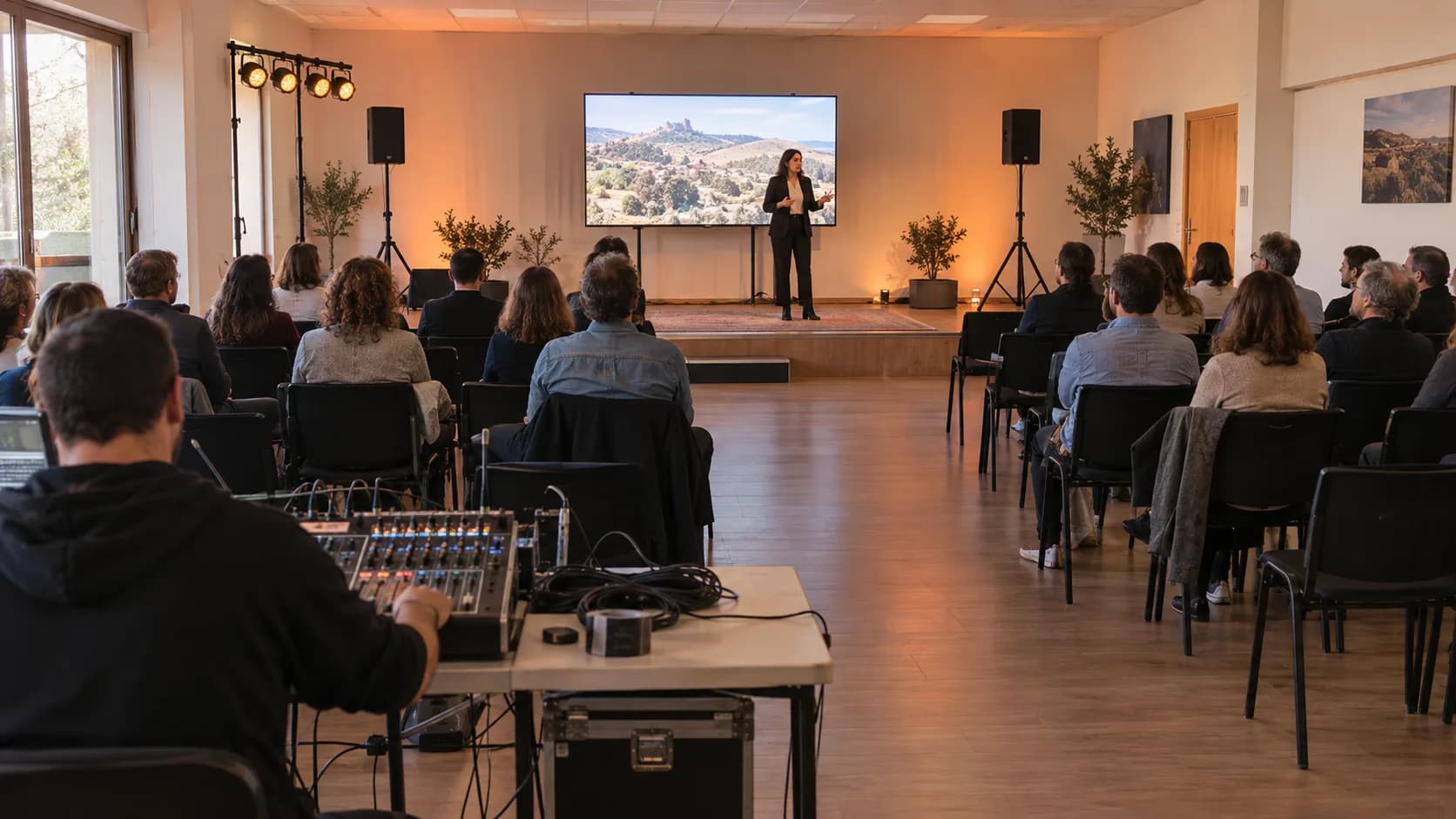
What it costs to hire an LED screen for an event depends mainly on the square metres, on the pixel pitch the audience distance calls for and on whether it goes indoors or out in full sun. Then come the structure, the number of days and the technician. Our LED screen hire for events is quoted exactly like that, item by item, and further down you will find the starting prices for each pack. First, here is what makes the figure go up or down, because two screens of the same size can end up at very different prices.
Why there is no single price per screen
An LED screen is not hired as one unit, like a projector. It is a set of modules joined together to build the surface the venue needs, with a processor that distributes the signal, something to hold it up and someone to rig it, calibrate it and take it down. That is why this trade talks about square metres rather than «a screen». The support screen on a stand and the backdrop of a concert share the technology, and not much else.
Surface area: square metres come first
Size is the first thing that moves the price, almost in a straight line: more modules mean more boxes in the truck and more hours of rigging. Our packs are organised precisely by surface: reinforcement and signage up to 6 m², stage and video wall between 12 and 40 m², and large format above 40 m².
Asking for more screen than the space needs is the quickest way to inflate a quote. Falling short also has a cost: nobody at the back of the room can read the slides. The starting point for getting it right is knowing how far away the last row is.
Pixel pitch: how close people will be looking
The pixel pitch is the distance in millimetres between LEDs. The rule of thumb technicians use is that the minimum comfortable viewing distance, in metres, is roughly the pitch in millimetres: a 3 mm panel looks right from about 3 metres and a 6 mm one from 6. The finer the pitch, the more LEDs per square metre and the more expensive the surface. A fine pitch makes no sense in a square where the nearest spectator is fifteen metres away, and plenty of sense on a trade fair stand where visitors walk past at one metre. If you are still torn between a screen and a projector for a room, we compare them in LED screens versus projection.
Indoors or outdoors
An outdoor screen costs more for two reasons. It needs far more brightness so the sun does not wash out the image, and it has to withstand damp, dust and wind. Outdoors the structure also stops being a detail: it has to be ballasted or anchored with the afternoon gusts in mind. Indoors it is the other way round: outdoor brightness is too much and gets turned down. For open-air concerts and fairs we go into this in the guide to giant LED screens for concerts and fairs.
Standing on the floor or flown
The screen can stand on a base on the floor (what the trade calls ground stack) or be flown from truss or from the venue's rigging points. Ground-stacked is quicker and cheaper to set up. Flown keeps the floor clear and sits higher, which is what a stage with a standing audience needs, but it requires structure and more crew hours. In hotel function rooms the ceiling decides for you: if there is no height or no rigging points, the screen goes on the floor.
Processor, live vision mixing and technician
Every LED screen needs a video processor that adapts the signal to the real resolution of the surface, and that is always included. What changes the quote is what goes on screen. Playing a logo or a presentation from a laptop is simple. Mixing several live cameras with captions and videos is live production, and it needs a vision mixer, cameras and one person dedicated to that alone. At a congress with speakers changing every half hour, that person is the difference between seeing the speaker's face and seeing their laptop desktop. In the video wall guide for congresses we explain how it is organised.
Days, schedules and travel
You are not only paying for the hours of the event. A stage screen is rigged and calibrated beforehand and taken down afterwards. If the venue only allows night-time setup, or the screen has to come down as soon as the event ends at two in the morning, those are crew hours that count. A second day with the screen already up repeats neither the transport nor the rigging, and that shows. Travel depends on the distance from our base in Albacete and is included in the quote: a fair in the city itself does not cost the same as a festival in Galicia.
What the price includes and what moves it
Our packs include the modular LED surface, the video processor, the structure or support, and rigging with calibration and teardown. The stage pack adds multi-camera live production, the truss and a production technician throughout the event. From there, the price rises when more surface or a finer pitch is needed, when the screen goes out in full sun or is flown, and when there is night-time setup or several days.
Starting prices for our packs
These are the «from» prices for each pack, taken from our current rates. They are a starting point: the final quote depends on the date, the place, the hours and the travel, and a person always reviews it before sending it to you. If a pack shows no price, it is because it is quoted per project.
| Pack | For | Includes | From |
|---|---|---|---|
| Support & signage | Support screen · up to 6 m² | Compact modular LED surface up to 6 m² · Video processor and content management · Structure, base or floor stand | 450 € |
| Stage & videowall | Stage / videowall · 12 – 40 m² | Modular backdrop videowall between 12 and 40 m² · Video processor and scaling to the surface · Multi-camera production with source mixing | 2500 € |
- Support & signageFrom 450 €Support screen · up to 6 m²Compact modular LED surface up to 6 m² · Video processor and content management · Structure, base or floor stand
- Stage & videowallFrom 2500 €Stage / videowall · 12 – 40 m²Modular backdrop videowall between 12 and 40 m² · Video processor and scaling to the surface · Multi-camera production with source mixing
Starting prices, kept up to date from our catalogue. The final quote depends on the date, the venue, the hours and the travel, and a person reviews it before it is sent. See packs and configure
What to send us when asking for a quote
The more information you give us up front, the fewer emails back and forth. You can send it through the contact form with the following:
- Date and times of the event, and whether the venue limits setup hours
- Exact location and whether the screen goes indoors or outdoors
- Audience size and approximate distance to the last row
- What you will show: logo, presentations, videos or live cameras
- Whether there is a stage and whether the venue has rigging points
- A photo or a floor plan of the space, if you have one
Frequently asked questions
Can you see an LED screen in full sun?
Yes, if it is an outdoor screen, which has much more brightness than an indoor one precisely for that reason. What does not work is taking an indoor screen to a town square at midday: the image looks washed out. If the sun will be shining straight at it at that time, tell us when you ask for a quote, because it changes how it is oriented.
Do I need a technician during the event?
Rigging, calibration and teardown are always done by a Zenor technician. During the event someone needs to be at the controls if content changes, there are several speakers or live cameras. In the stage and video wall pack the production technician stays for the whole event.
What size of screen do I need?
It comes from the viewing distance and the audience size, not from what fits on the wall. With the distance to the first and last rows we choose the pitch and the surface. If you send us a photo of the space, the calculation gets much more accurate.
Can I supply the content myself?
Yes. Normally you send us the videos or the presentation before the event so we can test them on the screen. One detail that saves headaches: if the surface is not 16:9, the content is best prepared to its proportions; otherwise you get black bars or a cropped image.
Is travel outside Albacete charged separately?
No. We work all over Spain and travel is included in the quote, calculated according to the distance to the event venue.