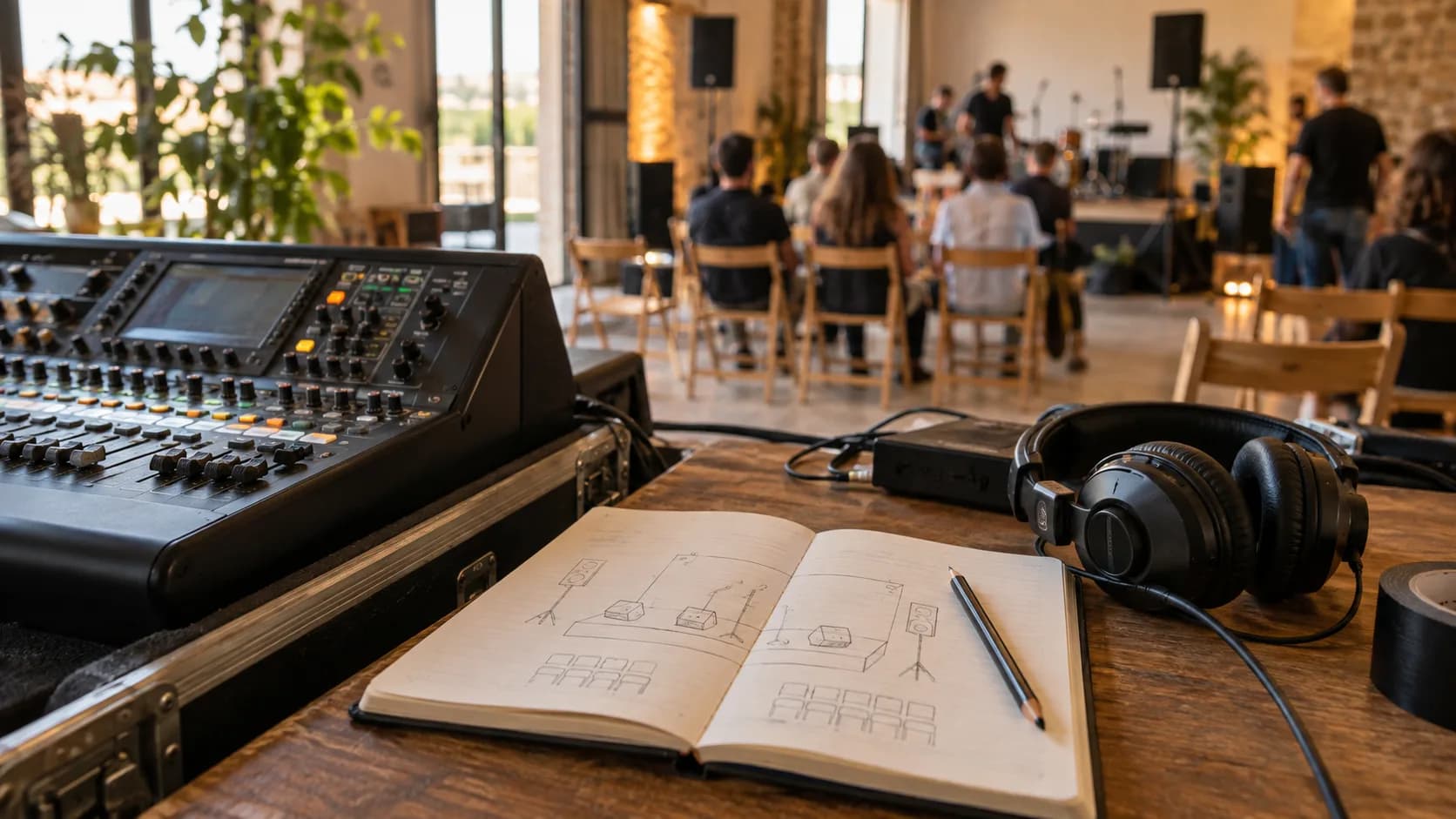
The technical rider is the document in which an artist or a band sets out what they need to perform: sound channels, microphones, monitors, lighting, stage, power and schedules. If you are booking the performance, ask for it before signing and go through it with the production company, because what the rider asks for is what you are going to have to provide.
The other half is yours: the artist does not know what your square, your sports hall or your venue is like. You have to tell them what is on site, what time the setup can start and who provides each thing. If the two halves do not match before the day, the problem shows up at the soundcheck, and whoever provides the event sound pays for it.
What a technical rider is and what it is not
The technical rider deals only with the technical side: what has to sound, be seen and be connected for the performance to work. It is not the same as the hospitality rider, which covers the dressing room, drinks, food or accommodation. Many artists send both in a single document, but it is worth reading them separately, because the technical one is handled by the sound and lighting company and the hospitality one by the organisers.
If the word turns up in a quote and you want to go over the rest of the terms (line array, DMX, backline…), they are explained in the audiovisual glossary for events.
What a technical rider usually includes
There is no single format, but a complete rider usually has these parts:
- Technical contact. The name and phone number of the person who makes the technical decisions for the artist, who is often neither the manager nor the person selling you the performance.
- Input list. What goes into the mixing desk: each voice, each instrument and each device, with its channel number and the microphone or connection it requires.
- Stage plot. A drawing seen from above showing where each musician, each instrument, each monitor and each power socket goes.
- Monitors. What each musician needs to hear on stage: floor speakers (wedges) or earpieces (in-ear), and how many separate mixes.
- Sound system for the audience (PA). What they expect to be heard out front. Sometimes it asks for specific brands; normally equivalents are accepted if you ask beforehand.
- Lighting. From a minimum so that the stage can be seen to a full lighting design with its own technician.
- Backline. The instruments and amplifiers: which ones the artist brings and which ones they ask the organisers for.
- Power. Which sockets they need on stage and whether they ask for a separate line for the sound.
- Stage. Dimensions, height, whether it has to be covered and how the equipment gets onto it.
- Schedules. Arrival, load-in, setup, soundcheck, performance and teardown.
What matters most for quoting is the input list and the stage plot. Without them, the production company has to guess, and whatever is guessed gets paid for twice or is missing on the day of the concert.
This is the list worth going through before signing with the artist:
- Is it the rider for this tour and this line-up? Check the date and count the musicians. If you are booking a reduced format and the rider is for the full band, ask for the right one.
- Does it include an input list and a stage plot? If either is missing, ask for it now. It is the first thing the production company will ask for.
- Is it clear what the artist brings and what you have to provide? Instruments, amplifiers, their own microphones, their own technician. If the rider says “provided by the organiser”, that goes into your budget.
- Do they bring their own sound or lighting technician? If they do, they mix and the production company hands over the equipment set up and assists them. If not, the technician is provided by whoever handles the sound.
- Does it ask for specific brands or models? Ask the technical contact whether they accept equivalents and get it in writing before signing, not on the day of the gig.
- Does it fit your space? Compare the stage dimensions they ask for with those of your square, your sports hall or your function room, and check how the equipment gets in.
- Do you have the power they ask for on site? If you do not know what is available, ask beforehand: in a square you may need a generator or a temporary mains connection, and that may involve its own paperwork and cost.
- Do the schedules fit with the rest of the day? If the same stage has another event in the afternoon, the artist's soundcheck has to fit in before it or be agreed some other way.
- Are there other artists on the same stage? Put all the riders together and have the production company prepare a setup that works for all of them and for the changeovers between performances.
- What happens if something cannot be met? Make sure the contract states who approves changes to the rider and that they are approved in writing.
- Is it outdoors? Check whether the rider requires a covered stage and what happens if it rains.
If any box is left blank, it is not a reason not to book the artist: it is what needs clarifying before signing, while there is still room to negotiate.
What the organiser has to give the artist and the production company
The artist's rider is answered with information about the venue. In the trade it is sometimes called a counter-rider; the name does not matter, what matters is that it reaches everyone. It includes:
- Address and access for loading. Where the van or lorry gets in, what time the street can be closed and where to park during the event.
- The space. Dimensions, photos and, if you have one, a plan. If it is in the street, what is around it: façades, trees, lampposts, changes in level.
- Power. Where the connection point is, what is available and who manages it.
- Schedules. From what time the setup can start, what time the performance starts and ends, and until when there is time to tear down.
- Permit limits. Finish time, volume or whatever the town council or the venue has set for you. If you are the one handling the paperwork, see insurance and permits for a municipal event.
- Expected audience. How many people you expect and where they will stand. That decides how much sound is needed and whether the back of the square needs reinforcing.
- A contact person for the day, with a phone number, who can make decisions.
- The dressing room and hospitality items, if the rider asks for them.
About the site visit: at Zenor we do not do a prior technical site visit by default. If you need one, you ask for it and it is quoted separately. The usual approach is to work from the photos, dimensions and plan you send us, and we prepare the setup from those.
Who provides what: artist, organiser and production company
This is the most common split. What counts is what you sign in each contract, so use it to check that nothing is left without an owner.
- Technical and hospitality rider. Artist: writes it and keeps it up to date. Organiser: asks for it before signing and forwards it. Production company: reads it and says what can and cannot be met.
- Own instruments and special microphones. Artist: brings them. Production company: connects them.
- Backline the rider asks the organisers for. Artist: specifies it. Organiser: hires it. Production company: provides it if it is included in their quote (ask).
- Sound for the audience (PA) and monitors. Artist: states what they need. Organiser: hires it. Production company: provides it, sets it up and tunes it.
- Mixing desk and sound technician. Artist: may bring their own technician. Organiser: hires the technician if the artist does not bring one. Production company: provides the technician or assists the artist's.
- Lighting. Artist: states the minimum or their design. Organiser: hires it. Production company: provides it, sets it up and operates it if there is no technician from the artist.
- Stage or platform. Artist: states the dimensions and whether it must be covered. Organiser: hires it or provides it (at local festivals, it is sometimes municipal). Production company: ask your supplier whether it is included.
- Power at the stage point. Artist: states what they need. Organiser: secures the connection point or the generator. Production company: distributes power to its equipment from that point; if there is no mains connection, ask whether they can supply the generator.
- Permits, event insurance, barriers and security. Organiser: handles the paperwork and hires them. Production company: ask them in writing for the documentation on their setup that the town council or the venue requires from you.
- Dressing room and catering. Artist: asks for them. Organiser: provides them.
- Schedule for the day. Artist: proposes theirs. Organiser: decides and communicates it to everyone. Production company: adjusts setup and soundcheck.
Who hires the sound: the artist or the organiser?
It depends on how the performance is agreed. Sometimes the organiser books the artist and separately hires the sound and lighting, and then the rider goes through their hands. Other times the artist or their agency comes with the technical side sorted, and the organiser only provides the space, the power and the schedules.
Both arrangements work if it is written down who pays for and who is responsible for each thing. What fails is the middle ground: each party thinking the other one is providing it.
An example of the technical side hired by the artist's party: at Califa Jerezano's live set at a wedding at the Los Aljibes estate (Chinchilla de Montearagón, Albacete), the sound was hired by the band's agency, Enjoy Music Spain. We tell the story with photos in wedding sound at Los Aljibes with Califa Jerezano.
The technical rider at town council or festival committee events
At local festivals, the town council or the festival committee usually books several performances and a single stage for all of them. There the rider matters even more, because several have to be combined into one setup:
- Gather the riders for all the performances before hiring the sound, lighting and stage, and send them together to the production company.
- If the technical side is contracted through a tender or a municipal procedure, attach the riders or summarise what they ask for, so that whoever bids quotes for the same thing that will later be required. How it is included in the tender documents is up to the town council itself: check with the procurement department or the council secretary.
- Plan the day: which performance sets up first, when each one does its soundcheck and how much time there is between them.
For the sound of the square itself (power, reinforcement for the back and coverage), you have the details in how to sound a town square for concerts. What we set up for town councils is gathered under town councils.
What to do if the rider asks for something you do not have
A rider can be negotiated. When something does not fit:
- Send the rider to the production company and ask them to tell you what can be met, what can be met with an equivalent and what cannot.
- With that answer, talk to the artist's technical contact, not to whoever sold you the performance.
- Put the accepted changes in writing and forward them to everyone.
What you should not do is sign the rider as it stands knowing that part of it will not be met: on the day of the concert there is no room to negotiate.
What we need to quote from a rider
We provide the sound and lighting through event sound and lighting, with our own technical equipment, without subcontracting. To quote, send us:
- The technical rider for each performance (including the input list and the stage plot).
- The venue, whether it is indoors or outdoors, and photos and dimensions of the space.
- How many people you expect.
- The setup, performance and teardown times.
- What the organisers already provide: stage, power, generator, marquees.
- Whether the artist brings their own technician.
With that we tell you what can be met from the rider, what we propose as an equivalent and what needs clarifying with the artist.