
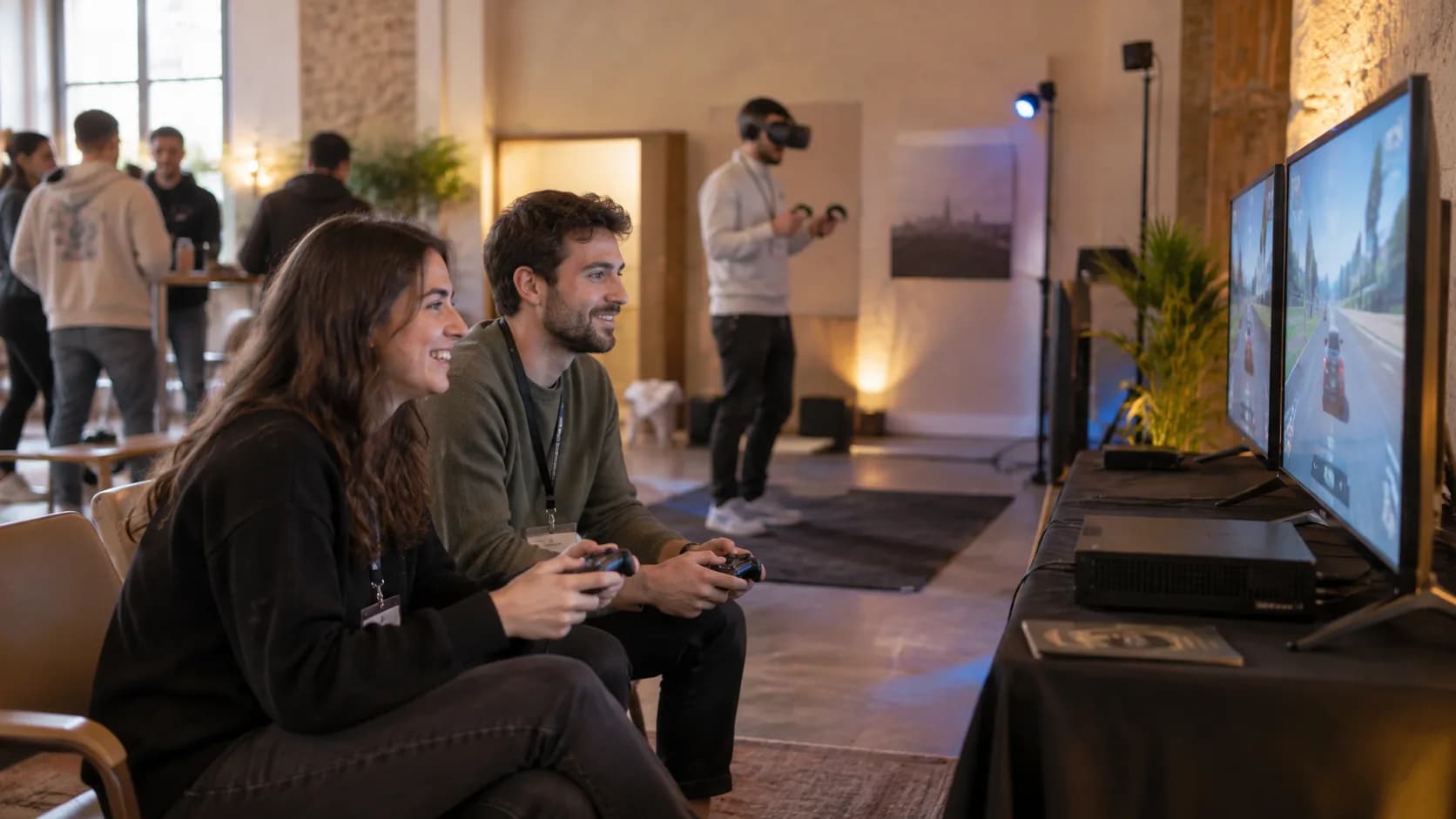
Setting up a gaming area at an event looks simple until forty people turn up at once and there are two controllers. The difference between a gaming area that works and one that generates a queue is not the console: it is how many stations there are, which games were chosen and whether someone is keeping an eye on it all still running at eleven at night. Here is what to decide before you ask for it.
Which console suits which type of event
It is not a question of raw power, but of how many people can play at once and how long it takes someone to understand the game. A Nintendo Switch with party games lets four people who have never held a controller start playing in thirty seconds. An Xbox Series X or a PlayStation looks better on a big screen and is what a young crowd or a tech fair wanting to show off graphics will ask for.
- First communions and children's birthdays: Switch, four-player games and short rounds
- Weddings with guests of all ages: Switch in a separate room, as an alternative to the dance floor
- Corporate events and team building: Xbox or PlayStation with tournaments and a visible scoreboard
- Fairs and brand activations: the most powerful console on a big screen, which is what stops a visitor
- End-of-school parties and youth events: a mix of both, with several stations running in parallel
How many stations you really need
The useful calculation is not «one console per X guests», because not everyone plays at once or all the time. What makes the difference is waiting time: if a round lasts five minutes and eight people are waiting at a single station, the last one waits forty. With two or three stations in parallel the queue disappears and the area stops being a bottleneck. At longer events people also come and go, so there is no need to size for the absolute peak.
The screen matters more than the console
A latest-generation console plugged into a small television in a brightly lit room looks like nothing. For a gaming area to be visible from a distance and pull people in, the screen and the light need the same thought as any other setup: LED screens or large monitors if the space is open and bright, and control of the lighting in that area so there are no reflections on the screens. It is the most common mistake: the console is chosen carefully and then placed facing a window.
Gaming audio either disturbs or adds
If the gaming area sits in the same space as the music or the speeches, console audio becomes noise. The usual answer is headphones or nearfield speakers, at a volume that only reaches whoever is playing, coordinated with the main event sound. At a trade fair it is the opposite: console audio is part of the draw and it should carry into the aisle.
Virtual reality: when it works and when it does not
VR headsets are the format that impresses most and moves the fewest people per hour, because each session is individual and the controls have to be explained. They work very well as the headline attraction of an event — the queue is part of the show — and badly as the only entertainment for two hundred people. The combination that works best is one VR station alongside several console stations that absorb the volume.
“A gaming area does not fail because of the console. It fails because nobody worked out how many people can play at the same time.”
What the hire includes and what you provide
At Zenor we bring the consoles, the controllers, the screens, the stands, the cabling and the games, and we set the area up and take it down. What we need from the venue is two specific things: a sufficient power supply near where the area will go, and to know whether the floor and the access allow us to bring the equipment in. At busier events we add staff to manage turns, which is what stops one group settling on a controller for the whole afternoon.
What we need to know to quote it
There is no fixed rate, because the price depends on the number of stations, the hours, the space and the travel involved. The starting packs, with their "from" price, are on the console hire for events page. With the date, the town, the type of event, how many people you expect and how many hours you want the area running, we prepare a proposal with the specific equipment and staff. A person on the team reviews it before it goes out.